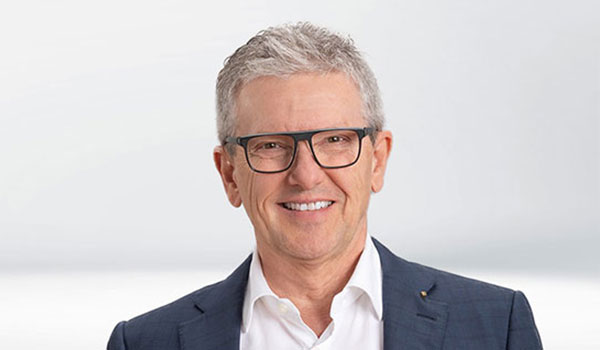
From its beginnings as a small Swabian company in contract software development to a listed IT service provider active throughout Germany – DATAGROUP has reinvented itself again and again in the course of its more than 35-year history. An interview with founder Max H.-H. Schaber about the history of the company.
Why did you decide to start your own company?
Every entrepreneur is probably asked this question. I could never imagine permanently being an employee. After three years as an employee, the thought matured in me that I could do it better myself. The background was the possible self-determination and freedom!
When you founded DATAGROUP, the company still had a different name and a different focus. What were those?
The company was called Datapec at the time, in reference to the personal computers that had just come onto the market. The main focus of Datapec was custom software development. We solved problems individually for customers and wrote software based on different programming languages. We relatively quickly won very large clients such as Audi and AEG and employed about 100 people.
Where did the company go from there?
Overall, the company has reinvented itself several times. At first, the focus was on custom software. Then we developed a new business model. We became what is known as an incubator. We looked for people in the market who had already had success in IT, for example as managing directors or technical directors of software or trading companies. We offered them a platform to invest in newly founded companies for a small amount of money. Before the term existed in Germany, we had already developed a start-up culture. But unlike today, we took care of the infrastructure and all the things that are often a nuisance for founders. For example, payroll, dealing with banks, how marketing works, etc. We gave money and infrastructure and were very successful with it. In total, we have founded more than ten companies, some of which have become extraordinarily successful.
One of these companies was a trading company that, after only a few years, had a turnover of almost DM 100 million with branches in six countries. The company bought computers from the USA and sold them to universities in Europe via catalogs. We were thus one of the eCommerce precursor companies. We sold the company when hardware margins fell sharply.
And then?
After that, we dedicated ourselves to software development again, this time in the healthcare sector. As KIS (Krankenhaus Informationssysteme GmbH) we developed a Hospital Information System together with Hewlett Packard and Anderson Consulting. It was the first system based on a relational database. That was before Oracle came on the market. The novelty of it was that you were able to determine the real production costs in the hospital, that is, how much does a case cost. We had almost 100 employees, at that time already in Pliezhausen, 36 hospitals as customers and no outside investors. Due to changes in hospital financing, the hospitals were unsettled and stopped investing for a while. We then looked for a partner – much too late, in fact – and found one in Jenoptik. We found ourselves in a pressure situation that shifted the balance in favor of the buyer and we had to sell the company without making a big profit. It was a very bitter time in my entrepreneurial life.
However, you didn’t give up, but continued with DATAGROUP. How did that come about?
We already owned a number of companies that operated in the environment of today’s DATAGROUP. Through acquisitions, we formed a company with a system house focus. We went public with this company, from the outset with the aim of playing an active consolidation role on the market.
What made you decide to go public as a medium-sized Swabian company?
Raising capital. Through our experience with KIS and this bitter sale, we knew what it was like to run out of money. To prevent this from happening again, we put our financing on a broader footing. An IPO enables better capital procurement.
When did the change from system house to IT service provider occur? What were the reasons behind it?
Back when we went public, we made about 26 million euros in sales from the system house business. We made good money, but 80 % of our sales came from the trading business. I realized early on that the retail business would come under increasing pressure in terms of margins. That also became apparent when companies like Bechtle, Computacenter and Cancom focused on retail, got bigger and bigger and put more and more pressure on margins. They had a completely different weight with the manufacturers. I foresaw this pressure on margins and thought: We can’t continue to struggle along on two or three percent. We need a higher return, greater customer loyalty – I like to say stickiness here – and we have to become an indispensable, not easily replaceable part of our customers’ service provision.
We wanted to grow as an active consolidator in the market and at the same time transform our business from a trading-oriented to an exclusively service-oriented business. That wasn’t easy; I also had to assert myself a lot internally.
From this experience – what is important for change to succeed?
First and foremost, you need a goal, a vision: Where do you want to go? Changing for the sake of changing makes no sense. Change only makes sense in order to achieve a goal.
The second important point is a clear structure of how this change should proceed, i.e. what steps are necessary for it. Breaking down the vision into individual steps according to the motto: If you want to climb a mountain, do it step by step.
The third point, which I consider indispensable, is to keep at it. Review the strategy, review the goal, continuously improve, iteratively solve the issues. Today, we would say that you have to be agile.
What do you see as the biggest changes DATAGROUP has undergone in its 35-year history?
Most definitely the development of CORBOX. For the first time, we had a goal that everyone in the company could be committed to. We had a common language and a common product world that everyone could get behind.
What changes are currently underway at DATAGROUP?
The company is being partially recentralized from a purely fractal, i.e. distributed organization. This means that we are bundling services that can be centralized, such as HR, Finance or Data Center, in shared services centers via so-called change processes. The SQUARE project was one of these changes.
The IT industry is also characterized by change. Which trends will change the industry the most in the future?
The trend towards as-a-service will become stronger and stronger. I would even go so far as to say that in five years there will no longer be any licensed commodity software. In addition, the trend towards multi-cloud environments and hybrid cloud environments will certainly continue to grow.
You can certainly be described as a serial entrepreneur who lives and drives change. What does someone have to bring to the table for this?
I certainly have extreme stand-up qualities. By that I mean that I don’t give up. As an engineer, I certainly also have the ability to look at things in detail and then judge for myself whether I want to get in there. It’s the ability to be awake, to be interested. When my kids asked: What do we have to learn to be as successful as you, I’ve always said: You have to be able to stand going down ten times a day and getting up an eleventh time.
How do you see your time after DATAGROUP?
Currently, for my time after DATAGROUP, I am developing a group of civil engineering companies that lay the last mile fiber to the customer, i.e. communications infrastructure. Here I recently bought a company that will be the core of my buy and build strategy in the area. Also, again, I’m involved in the health care software area, but that all falls into the area where I’m an investor.
How do you see the future of DATAGROUP?
Of course, the entire economy is in a difficult situation right now. However, we are operating in exactly the right market segment, have a very good portfolio and excellent relationships with our customers. I therefore believe that we are only at the beginning of our great success. I therefore see the future of DATAGROUP as rosy, sunny, very successful.
Mr. Schaber, thank you very much for this interview!
Since its beginnings 20 years ago, the Technical Field Service (TFS) has undergone many changes, but the basic tasks have remained the same: The colleagues at the TFS look after IT workplaces in Germany.
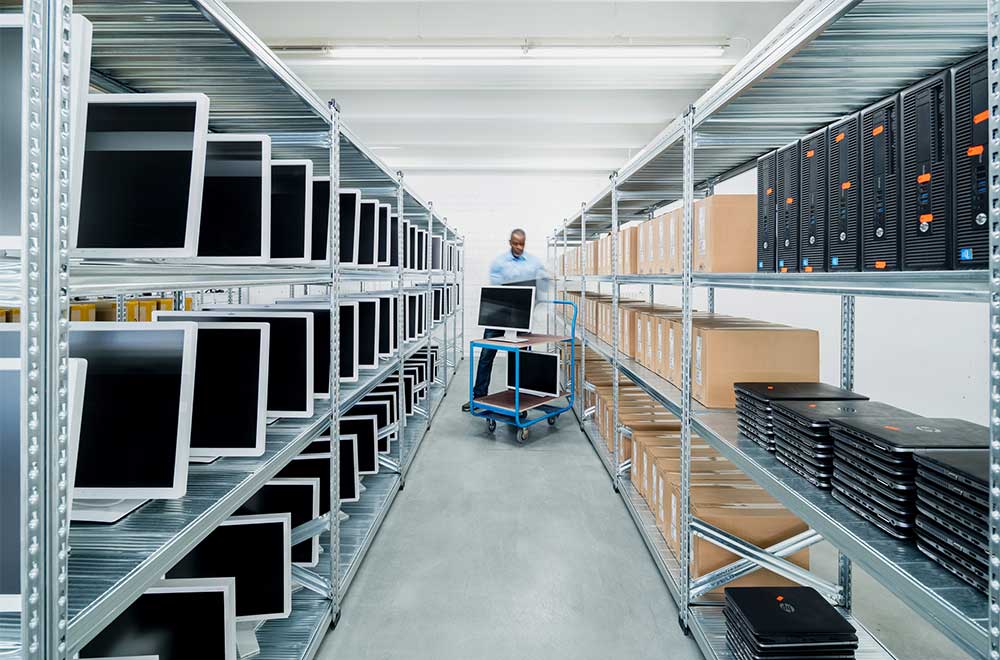
The TFS arose from an IT outsourcing project in 1999, in which DATAGROUP took over the rollout in the cultural administration. In the course of this project, the wish emerged for a partner who could support IT workstations on site. The Technicasl Field Service was established. The range of tasks was broad from the very beginning and to this day covers the entire client lifecycle: from hardware procurement, installation, relaocation, adding, updating and modification of new software and hardware to the proper disposal (IMAC/RD). In addition, the TFS also handles the packaging of software and the sets up customer clients.
Servicetechniker Gerhard Böhmler aus Stuttgart war von Anfang an dabei und erinnert sich: „Wie haben mit einer recht kleinen Anzahl an Technikern begonnen, die die gesamte Bandbreite der Aufgaben abgedeckt haben. Im Laufe der Jahre sind wir immer größer geworden, haben immer mehr Arbeitsplätze betreut und uns im Team zunehmend spezialisiert. Aktuell betreuen wir aus Leinfelden heraus rund 50.000 Arbeitsplätze. Aber das Teamgefühl der ersten Zeit, das ist immer noch da, genauso wie die Freiräume, seine Aufträge selbstbestimmt zu erledigen.“
Service Technicial Gerhard Böhmler from Stuttgart was there from the very beginning and remembers: “We atarted with a rather small number of technicians who covered the entire range of tasks. Over the years, we have grown, looked after more and more workplaces and became increasingly specialised within the team. We currently look after around 50,000 workplaces from Leinfelden. But team spirit from those early days is still there, as well as the freedom to work your tasks independently.”
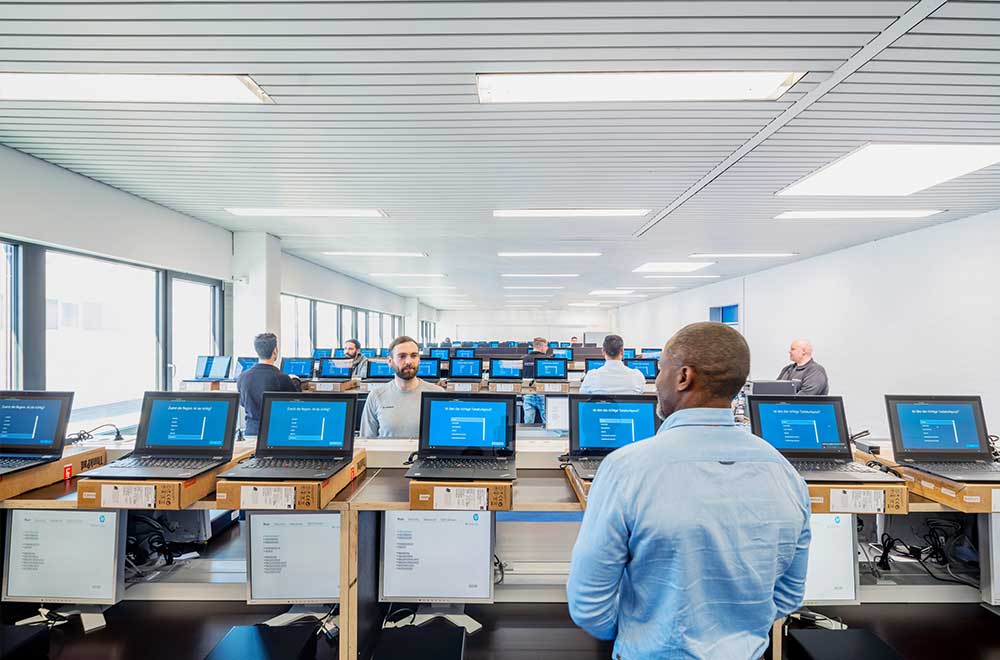
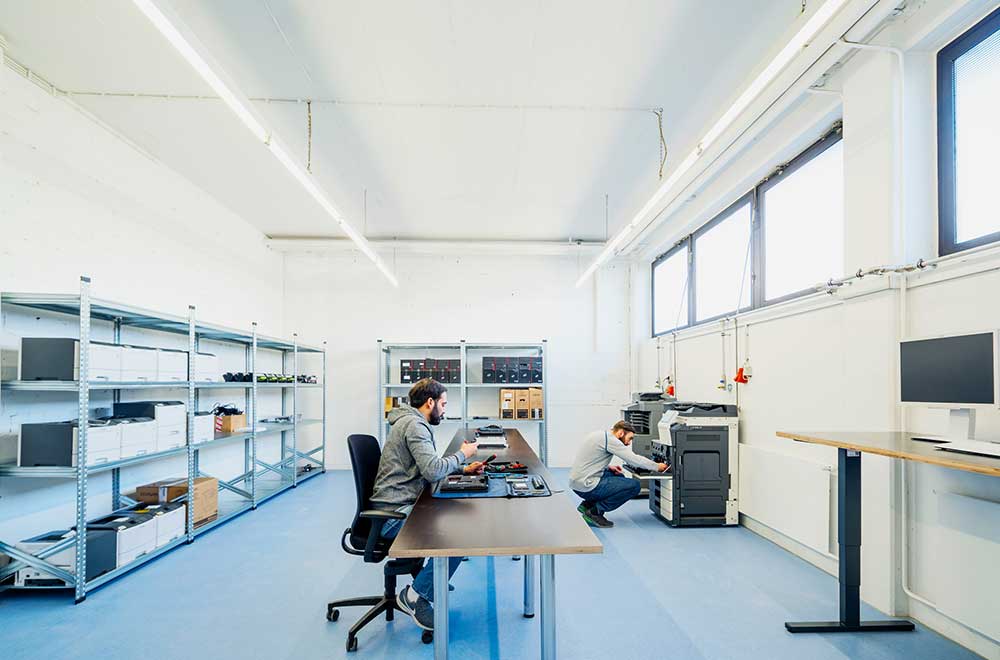
Some things have changed radically over the last 20 years. Cloning, i.e. the refuelling of end devices with the right software, is now carried out in the new premises in Leinfelden near Stuttgart via a modern cloning line. Up to 300 can be cloned in parallel and in 3-shift operation. A big difference from the beginnings. “We used to have a mobile cloning server in a van,” says Gerhard Böhmler. “We drove to the customer and could clone the devices in the car.”
Over time, the team grew, as did the number of workplaces supprted. Many custromers from the early days are still loyal to the TFS today or returned to the TFS after short interruptions. This growth is also reflected in the fact that in 2019, the team in Baden-Württemberg moved to new premises in Leinfelden near Stuttgart. On a storage area of more than 4,500m2 ther is space for the hardware for rollouts, repair processing and the spare parts warehouse for customers.
Christoph Voelter, Head of Technical Field Service about Leinfelden: “We can now dovetail the individual specialists much better: Logistics, cloning, roll-out and repair can work hand in hand, so customers don’t have to worry about their IT – it just works.

It is not always easy to pursue an education alongside a fulltime job. Marcus Schäfer, service manager at DATAGROUP, knows it very well, because he has studied alongside his day time job for years.
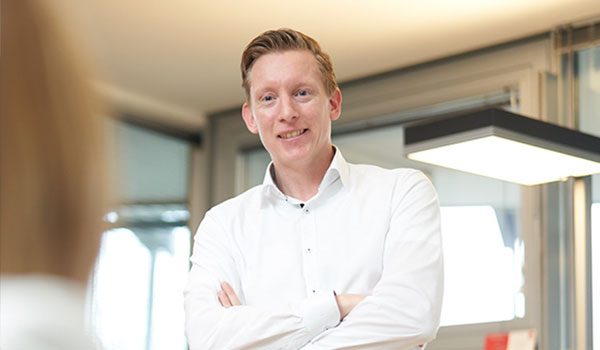
Marcus has worked for DATAGROUP for years. He has completed his apprenticeship as IT specialist here. Following positions in technical fields and in project management, he changed to service management. So continuous development is nothing new to him.
“I consider it important to further educate myself on a regular basis. Especially today, and especially in IT, so many things are changing so fast that it is good to leave the traditional path in terms of training and focus on regular continuing training instead, also on the job”, explains Marcus.
For years, Marcus has studied business administration by correspondence course alongside his full-time job. He got up earlier, learned, and drove to work. His studies were paid by DATAGROUP, as the company supports an employee’s efforts to further educate themselves.
“Back then, it certainly was exhausting but it paid off. You gain insights you do not necessarily gain on the job, but which you can put into use afterwards”, explains Marcus, who acquired his business administration degree in 2015.
This flexibility is important in his daily work, as he is the primary contact for his customers. He makes sure that these customers receive the services they ordered and have a partner who supports them in their further development. To this end, he must also look into the customers’ business processes, understand these processes and have an overview of new technologies to advise them as best as possible.
With the constant arrival of new customers from different industries, who have individual requirements, Marcus benefits from his studies and his willingness for further development. “I am glad I could do what I wanted and that my employer will support me when I want to continue my education”, says Marcus.