Skip to content
Cybersecurity Header 3840x1400px5

Security Services

MSSP with a 24/7 Security Operations Center for Comprehensive Cybersecurity

Comprehensive Security Services for Modern IT Environments

Anyone who operates an IT system must take a strategic approach to IT security. Attacks are becoming more complex, and threats are increasingly shifting toward identities, endpoints, and hybrid cloud environments. Traditional basic measures such as firewalls or antivirus protection alone are no longer sufficient.

As a Managed Security Service Provider (MSSP), DATAGROUP supports companies with comprehensive security services: from risk analysis and preventive protection to professional response to IT security incidents. Our security architecture is based on the internationally established NIST Framework, which consists of the phases Identify, Protect, Detect, Respond, and Recover.


Your Benefits at a Glance

  • Comprehensive, product-independent security strategies
  • 24/7 Security Operations Center for handling IT security incidents
  • Early threat detection using SIEM and XDR technologies
  • Certified security processes in accordance with ISO 27001 and BSI standards
  • Sustainable assurance of data security and system availability

Managed Security Operations Center (SOC)

As an MSSP, DATAGROUP operates a 24/7 Security Operations Center (SOC) to continuously monitor security-related systems. The SOC serves as the central hub for the detection, analysis, and coordinated handling of IT security incidents and enables a rapid response to emerging threats.

Key Features:
  • 24/7 monitoring of security-critical systems
  • Structured analysis and prioritization of IT security incidents
  • Defined incident response processes with clear lines of responsibility

Security Information and Event Management (SIEM)

Our SIEM service collects and correlates security-related event data from complex IT environments. As an IT security firm, DATAGROUP uses predefined use cases; suspicious activities are detected in real time and trigger the actions specified in the use case to minimize the risks of a successful attack.

This allows potential IT security incidents to be identified before they have a business-critical impact.

Key Features:

  • Centralized log correlation across heterogeneous systems
  • Real-time detection of security-related anomalies
  • Use-case-based attack detection

Managed XDR – Extended Detection & Response

Managed XDR extends traditional event analysis to include cross-system threat correlation. As an IT security service provider, we integrate various security sources to identify complex attack patterns at an early stage.

The intelligent linking of event data improves data security and reduces response times to IT security incidents.

Key Features:
  • Cross-system threat correlation
  • Automated response mechanisms
  • Integration into existing security architectures

Managed EDR – Endpoint Detection & Response

Endpoints are a prime target for attacks. Managed EDR continuously monitors servers and clients and detects even advanced threats such as malware or suspicious process activity.

As an IT security firm, we thus provide additional layers of protection within the company’s IT infrastructure.

Key features:

  • Server and Client Monitoring
  • Analysis of suspicious activity on endpoints
  • Containment of Compromised Systems

Vulnerability Management

Vulnerabilities can occur anywhere—in existing systems, in new systems, in the software itself, or due to insecure configurations. Our Vulnerability Management Service identifies and assesses these risks in a structured manner.

This reduces potential points of attack and proactively prevents IT security incidents.

Key Features:

  • Regular vulnerability analyses
  • Risk assessment and prioritization
  • Recommendations for remediation

External Attack Surface Management

External Attack Surface Management examines your IT infrastructure from the perspective of potential attackers. As an IT security service provider, we continuously analyze publicly accessible systems for digital attack surfaces.

Through transparent assessment of external risks, we strengthen data security and minimize the likelihood of IT security incidents.

Key Features:

  • Analysis of external attack surfaces
  • Identification of exposed systems
  • Continuous risk monitoring

Security Based on the NIST Framework: Identify, Protect, Detect, Respond, and Recover

Our Security Services cover every phase of modern information security. Working closely with our customers, we conduct structured security assessments, identify risks, and develop tailored security strategies aligned with their specific business requirements.
 
Rather than relying on isolated point solutions, we take a holistic approach to security, building integrated security architectures that work seamlessly across the entire IT landscape. As a trusted cybersecurity partner, we combine technology, processes, and governance into a consistent and effective security model that strengthens resilience and supports sustainable business operations.
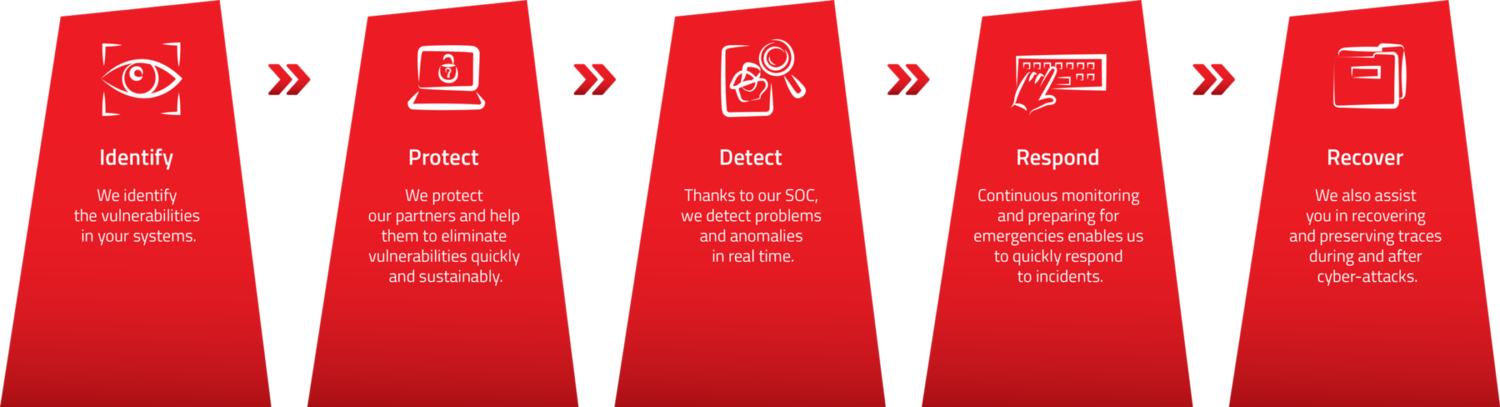
 Infographic showing the cyber security lifecycle: Identify vulnerabilities, protect systems, detect threats in real time, respond to incidents, and recover after cyber-attacks.

Graphic with arrows highlighting three core goals of cyber security: to prevent cyber-attacks, to detect threats continuously, and to respond to incidents.


Talk to us about your project

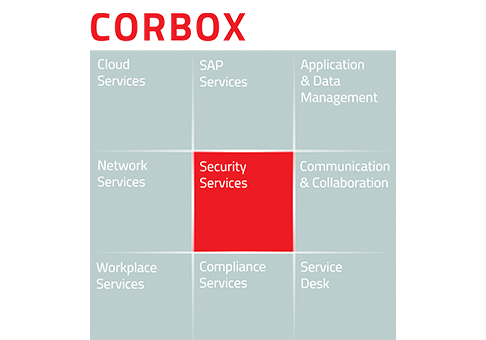
A rectangle showing all CORBOX services. The Security Service is highlighted.

Security Services as a Core Component of CORBOX

DATAGROUP’s Security Services are embedded in CORBOX – the modular service portfolio for holistically managed IT operations. CORBOX stands for “Corporate IT out of the Box” and describes a standardized, certified service model that integrates technical services, operational processes, and governance.

In the context of security, this means that monitoring, incident response, infrastructure, cloud, network, workplace, and service desk are all interconnected rather than operating in isolation. Security measures are not implemented as standalone technologies but as integral components of a coordinated overall architecture.

This structured integration results in clear responsibilities, transparent processes, and a consistent level of security across all IT areas.

Learn more about Corbox

Security Services Customer Projects

Bauarbeiter auf einer Baustelle mit Vermessungsgerät, Kran und Stahlkonstruktionen im Hintergrund bei Sonnenuntergang.

STARK Germany – Secure IT Transformation as Part of a Carve-Out

As part of an IT carve-out, DATAGROUP supported STARK Germany in establishing a secure and high-performance IT landscape. Security services such as mobile device management, along with the secure operation of network and infrastructure services, laid the foundation for secure and stable IT operations following the separation from the parent company.

Learn more about the IT carve-out at STARK Germany

Moderne Glasfassade des Drees & Sommer Gebäudes bei Sonnenuntergang, mit leuchtenden Lichtern und Spiegelungen in der Fassade.

Drees & Sommer – Mobile Device Management for Greater Security and Control

DATAGROUP implemented a mobile device management solution for Drees & Sommerto centrally manage and secure mobile devices. Security policies, device control, and standardized management processes help reliably protect company data on smartphones and tablets and support compliance requirements for mobile work.

Learn more about Mobile Device Management at Drees & Sommer

FAQ – Frequently Asked Questions About Security Services

What does a modern Security Operations Center (SOC) entail?

A Security Operations Center monitors IT systems around the clock, analyzes security-related events, and coordinates the response to IT security incidents. The goal is to detect and assess threats early on and to implement structured countermeasures.

How are IT security incidents detected?

IT security incidents are identified using technologies such as SIEM (Security Information and Event Management), XDR (Extended Detection & Response), and EDR (Endpoint Detection & Response). These systems analyze log data, correlate events, and detect anomalies in real time.

What role does vulnerability management play in data security?

Vulnerability management identifies and assesses vulnerabilities in IT systems before they can be exploited. Through regular analyses and prioritized measures, the attack surface is reduced and data security is strengthened in the long term.

What distinguishes an IT security service provider from a provider that offers only tools?

An IT security service provider integrates security solutions into a holistic operational model and provides ongoing support for them. A key component of this is a 24/7 Security Operations Center (SOC) that monitors security-related events, analyzes threats, and coordinates the handling of IT security incidents. This is complemented by consulting services, preventive security measures, and clearly defined incident response processes.

Can security services be integrated into existing IT environments?

Modern security services have a modular design and can be integrated into on-premises, cloud, or hybrid IT environments. A key factor is a coordinated architecture that takes existing systems into account and connects core security mechanisms.

Get advice now